
Canada Is Quietly Dismantling Digital Privacy - And You're Probably Not Paying Attention
Sign the petition here - https://www.ourcommons.ca/petitions/en/Petition/Details?Petition=e-7416
A Quiet Shift in Canadian Digital Privacy
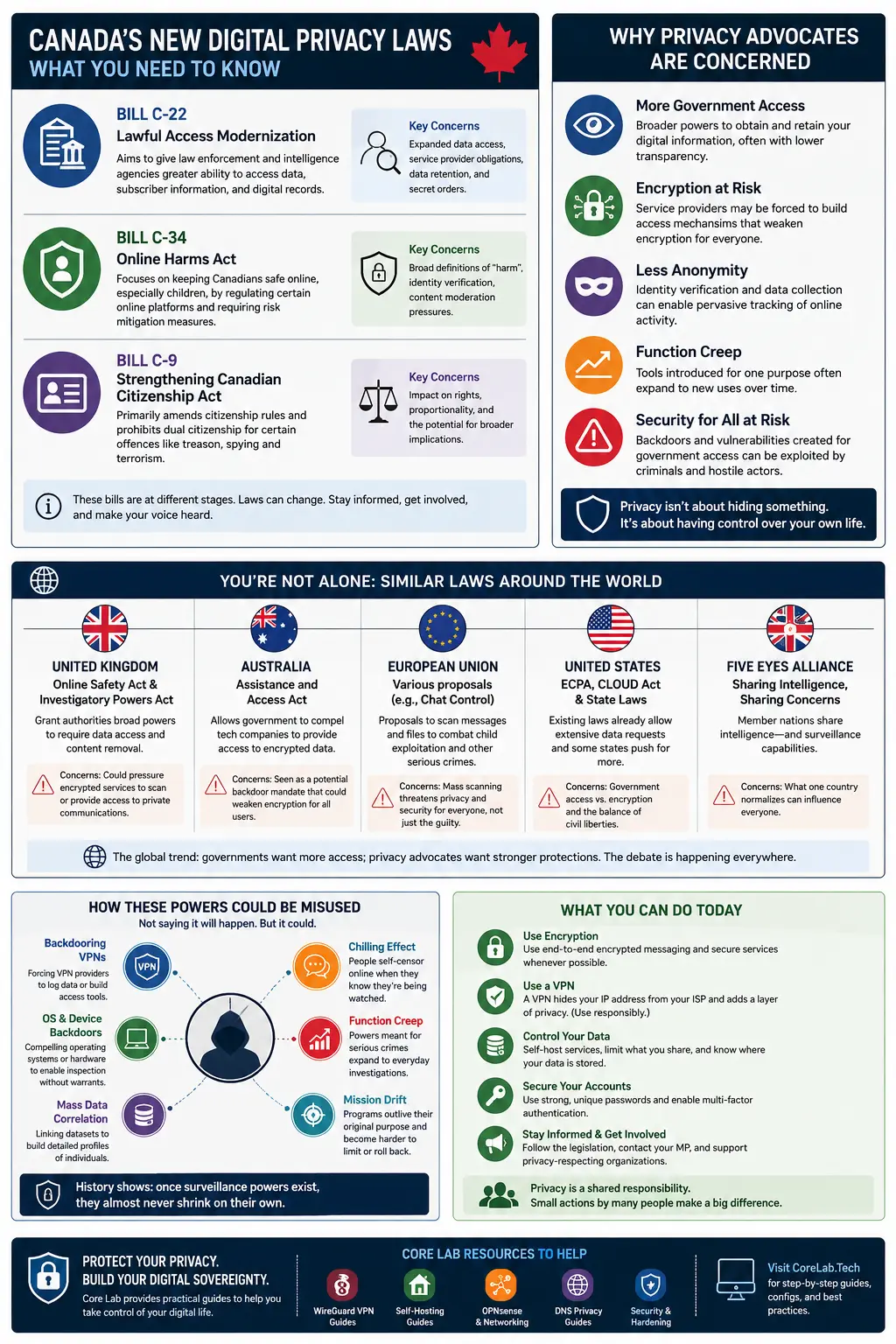
If you've been following the legislative fire-hose coming out of Ottawa in 2025 and 2026, you might have caught headlines about hate crimes legislation or online safety for kids and moved on. Reasonable - these things sound good on their face. By and large I think the majority of people agree that the internet and mostly, social media has gotten out of hand, and we want children protected, and hate crimes and infringement on free speech, stifled and prosecuted.
But buried inside three concurrent federal bills is a surveillance architecture that, taken together, represents the most significant erosion of Canadian digital privacy in a generation.
This isn't tinfoil-hat territory. These new laws have drawn such powerful negative attention that multiple companies have threatened to leave Canada entirely:
- Signal has threatened to leave Canada.
- Windscribe - a Toronto-headquartered & Canadian VPN - has said it will relocate its headquarters out of Canada.
- NordVPN is considering the same.
- Apple, Meta, and even the Canadian Chamber of Commerce have all raised the alarm.
- Even chairs of the U.S. House Judiciary and Foreign Affairs Committees have written to Ottawa warning that one of these bills threatens American national security.
Let's break down what's actually in these bills, what the realistic worst-case scenarios look like, and - critically - what you can do about it right now, armed with some knowledge and new skills.
Regardless of where you stand politically, these developments deserve attention because they affect every Canadian who uses the internet.
The Bills: What They Say vs. What They Mean
Bill C-22 - The Lawful Access Act (March 2026)
This is the big one. Introduced by Public Safety Minister Gary Anandasangaree in March 2026, Bill C-22 is the standalone successor to the sweeping surveillance provisions that were buried inside Bill C-2 (the Strong Borders Act) in June 2025. Those warrantless demand powers drew such universal backlash - from civil liberties groups, legal scholars, the opposition parties, and the tech industry - that the government was forced to strip them out and return with a dedicated bill.
The federal government's stated position is that law enforcement and intelligence agencies are increasingly unable to access information they are already legally authorized to obtain because modern technologies, encrypted communications, and cloud services have outpaced existing laws.
According to Public Safety Canada, the legislation is intended to modernize investigative capabilities while preserving Charter protections and judicial authorization requirements. Critics argue that the bill could establish the technical framework for broader surveillance capabilities in the future.
Privacy Commissioner submissions, legal experts, and technology companies have raised concerns regarding:
- Expanded access to subscriber information.
- New obligations imposed on electronic service providers.
- Data retention requirements.
- Confidential ministerial orders.
- Reduced transparency regarding government access requests.
- Potential pressure on encrypted services.
Importantly, the government maintains that the legislation does not authorize mass surveillance and does not explicitly require encryption backdoors.
I personally think it's a VERY slippery slope. Once the technical caveats are met and a system is in place, it's very easy to want to use and abuse it. Anyone remember what Snowden leaked about the USA?
Why Encryption Matters
Strong encryption protects far more than private messages.
It protects:
- Online banking.
- Password managers.
- Medical records.
- Business communications.
- Government systems.
- Journalists and whistleblowers.
- Everyday Canadians from cybercriminals.
One of the central concerns raised by privacy advocates is that any government-mandated access mechanism creates additional attack surfaces. The cybersecurity community has repeatedly argued that there is no known way to create a backdoor that can only be used by "good actors." If a vulnerability exists for one party, it can potentially be discovered and abused by others. This is especially true with the advent of "hacker" AI systems like autonomous LLM-driven exploit frameworks, or worse yet Mythos...
This is why companies such as Apple, Google, Meta, Signal, Proton, NordVPN, Windscribe, and ExpressVPN have publicly expressed concerns regarding the direction of Canada's lawful access proposals. They won't risk their own customer's information, their reputations, and their infrastructure!
Breaking Down Bill C-22
The revised version contains two parts, and they need to be understood separately:
Part 1 - Subscriber Access: Replaces the original warrantless demand with a "confirmation of service demand" (limited to telecoms) and a "subscriber information production order" - which still only requires a judge-reviewed "reasonable grounds to suspect" standard. That's the lowest investigative threshold in Canadian criminal law, and a significant step down from the "reasonable grounds to believe" standard that has governed general production orders for a decade. The government frames this as an improvement. Critics argue it's still constitutionally shaky and ripe for mass fishing expeditions.
Part 2 - The Infrastructure Play: This is where it gets genuinely alarming, the Supporting Authorized Access to Information Act, requires a broad range of "electronic service providers" - well beyond traditional telecoms - to build and maintain real-time interception and monitoring capabilities so that law enforcement and CSIS can plug into those systems when "authorized." Meta's public position on the bill states it could require companies to "build or maintain capabilities that break or weaken encryption, and force providers to install government spyware directly on their systems."
Part 2 also introduces mandatory bulk metadata retention of up to one year - capturing communication patterns, device identifiers, connection timestamps, and location data for every Canadian with no connection to any criminal investigation.
What does "metadata" actually mean here? It's not the content of your messages - it's who you contacted, when, from where, for how long, and on what device. Intelligence analysts have long argued this is more revealing than content. As former NSA director Michael Hayden put it: "We kill people based on metadata."
Fact-check note: The government's Department of Justice page maintains that the new tools "would not enable law enforcement to conduct warrantless searches of personal information." This is technically accurate for Part 1 in isolation. What it does not address is Part 2's mandatory interception infrastructure requirements, the reduced evidentiary threshold, or the bulk metadata retention mandate. The concerns raised by the EFF, OpenMedia, the Canadian Civil Liberties Association, and multiple legal scholars are well-documented and substantive - not hyperbole.
Bill C-34 - The Safe Social Media Act (June 10, 2026)
The newest entry, tabled just days ago. Bill C-34 creates two new statutes: the Digital Safety Act and the Digital Safety Commission of Canada Act. The stated goals are protecting children online, regulating AI chatbots, and imposing platform duties on social media services.
The concerns from the privacy community centre on several specific provisions:
- The Digital Safety Commission is a powerful new "super-regulator" that would have broad authority to issue guidelines, conduct investigations, and compel compliance from any "regulated service" - including AI chatbots. Critics, including law professor Michael Geist, have called it an unprecedented concentration of power in an unelected body with minimal judicial oversight.
- Age verification requirements extend to chatbots under Section 22, meaning platforms could be compelled to implement identity-verification systems that create new databases of who is using what service, when.
- Mandatory disclosure of law enforcement notification criteria: Digital safety plans must disclose the criteria under which operators notify the RCMP or other agencies of content - effectively baking surveillance triggers into platform policies by law.
- A separate bill tabled shortly after, Bill C-36 (the Protecting Privacy and Consumer Data Act), has drawn criticism for stripping the Privacy Commissioner of authority over private-sector privacy law and handing it to the same five-member Digital Safety Commission - a single body now regulating both content and personal data, with no independent counterbalance.
Bill C-9 - The Combating Hate Act (September 2025 / Senate, 2026)
Bill C-9 is the most debated of the three in mainstream media, and the connection to digital privacy specifically is more indirect - but the implications for online speech are real. Introduced as the Carney government's signature response to rising antisemitism, the bill amends the Criminal Code to create new hate crime offences, new intimidation and obstruction offences around places of worship, and a new offence targeting the wilful promotion of hatred.
While Bill C-9 textually codifies the Supreme Court’s high bar of 'detestation and vilification,' the real danger lies in its execution. The Canadian Bar Association has pointed out that the bill’s bizarrely worded 'clarification' clauses actually confuse the legal thresholds rather than clearing them up. Combine that with incredibly broad definitions of what constitutes network 'interference' or 'obstruction' near cultural conversations, and you create a structural framework ripe for algorithmic censorship. Critics including the Canadian Civil Liberties Association, the Canadian Labour Congress, and the Ligue des droits et libertés have warned this creates tools that, historically, tend to be used against marginalized and dissenting groups, not just the hateful.
The digital dimension: online speech is the primary enforcement target of hate propaganda law. A broader, more subjective hate definition - enforced by a new Digital Safety Commission with wide investigative powers - creates real chilling effects for activists, journalists, and dissidents operating online.
Fact-check note: Bill C-9's stated goals around combating hate crimes are legitimate. The documented concern is that the bill was rushed through the House Justice Committee and given minimal debate time at third reading. The broadened definition and interaction with C-34's enforcement apparatus is where legal experts concentrate their concern - not the anti-hate intent itself.
The Insidious Tech Implications: What This Actually Enables
So in my mind, this is how it all plays out on the tech side, with these laws individually, and then together.
1. VPN Services Could Be Compelled to Cooperate - or Leave
Part 2 of Bill C-22's interception capability requirements apply to any "electronic service provider" - language broad enough to encompass VPN providers and Internet Service Providers (ISPs). A VPN that routes Canadian traffic and is incorporated in Canada would, under this framework, potentially be required to maintain real-time interception capabilities accessible to CSIS and law enforcement.
This is exactly why Windscribe announced it would move its headquarters out of Canada, and why NordVPN has hedged its Canadian operations. A VPN that has built a backdoor into its own infrastructure is, definitionally, not a VPN worth using. The corporate privacy policy is irrelevant if the government has a direct tap.
What this means for you: Canadian-incorporated VPN providers operating under C-22 may not be trustworthy as privacy tools.
2. Operating Systems and Devices Could Be Subject to the Same Framework
"Electronic service provider" is intentionally broad. Device manufacturers, OS developers, and app stores could all be swept into the C-22 framework. This is precisely the concern Apple raised publicly. The UK's experience under its Investigatory Powers Act is instructive: in 2025, the UK government issued a Technical Capability Notice demanding Apple provide backdoor access to iCloud encrypted backups for British users. Apple challenged it in court, but the order itself was secret - there was no public disclosure that it had been issued at all.
Canada's C-22 does not include equivalent secrecy provisions as of the current draft, but the interception capability mandate creates the structural precondition for exactly this kind of order.
3. Metadata Retention Is Surveillance at Scale
The one-year bulk metadata retention mandate doesn't require a warrant, doesn't require suspicion, and doesn't require you to be a target. It simply requires your ISP and electronic service providers to log and store your connection metadata - (Just when we hoped hard drive prices would go down eh? 😭) building a detailed map of your digital life that can be accessed later under the lowered "reasonable suspicion" standard.
This is surveillance infrastructure. It just happens to be built and operated by private companies, with a government right of access.
4. The Chilling Effect Is Real
When broad hate speech definitions combine with a new super-regulator with investigative powers and mandatory law enforcement notification triggers built into platform policies, the result is structural pressure on online speech. You don't need to be charged for the system to work as intended, the possibility of investigation is enough to change behaviour.
Canada Is Not Alone (Five-Eyes Community)
Canada is far from the only country pursuing expanded online regulatory and surveillance powers. Similar debates have emerged across much of the Five Eyes alliance and the broader G7.
United Kingdom
The UK's Online Safety Act and Investigatory Powers framework have generated significant controversy due to concerns that encrypted messaging services could eventually be required to scan or provide access to user communications.
Apple previously withdrew certain encrypted services from the UK market rather than comply with some government demands.
The Identification Question
Another emerging concern is online identity verification.
While protecting children online is a widely supported goal, many privacy advocates worry that mandatory age verification or identity verification requirements can evolve into broader digital identification systems.
Potential risks frequently cited include:
- Data breaches involving identity databases.
- Chilling effects on anonymous speech.
- Expanded tracking of online activity.
- Increased barriers to privacy-focused services.
- Mission creep beyond original legislative purposes.
History has repeatedly shown that systems introduced for one purpose often expand over time.
That does not mean expansion is inevitable, but it does mean Canadians should pay close attention to how these frameworks evolve.
A Case Study - Australia: The Assistance and Access Act (2018, Still in Force)
Australia led the Five Eyes in this race. The 2018 Assistance and Access Act allows government agencies to issue Technical Assistance Requests (voluntary), Technical Assistance Notices (compelled assistance using existing capabilities), and Technical Capability Notices (compelled development of new capabilities). The systemic weakness provision, which nominally prohibits requiring "backdoors" - has been criticized by legal scholars as inadequately defined and procedural complex enough to be practically unenforceable.
The Act applies to any "designated communications provider," including device manufacturers, cloud storage services, and open-source software maintainers. Apple publicly called the draft bill "dangerously ambiguous." Critics correctly note that any backdoor created for Australian law enforcement cannot be technically constrained to Australian law enforcement, the vulnerability exists for any actor capable of finding or obtaining it.
European Union: Chat Control
The EU has cycled through multiple versions of its "Chat Control" proposal - a regulation that would mandate client-side scanning of all private messages for CSAM. Privacy advocates and cryptographers have universally characterized this as the functional equivalent of banning end-to-end encryption: you cannot scan message content before encryption and claim the message is end-to-end encrypted. The European Commission reached a Council position in late 2025, though the final form remains contested among member states.
Various proposals across Europe have sought methods to combat child exploitation and other serious crimes online while preserving encryption.
These efforts have repeatedly encountered resistance from privacy experts who argue that scanning technologies and exceptional access mechanisms inevitably create privacy and security risks.
The common theme is clear:
- Governments increasingly view encryption and anonymity as obstacles to investigations.
- Privacy advocates increasingly view government access requirements as threats to security itself.
United States: EARN IT Act, and the FBI's Ongoing Push
The US has so far failed to pass equivalent legislation, though not for lack of trying. The EARN IT Act, various iterations of the CLOUD Act, and the FBI's sustained lobbying effort to mandate "lawful access" encryption backdoors have all been beaten back - partly because the US tech industry has more direct lobbying power in Washington than anywhere else. However, the US does operate PRISM and other surveillance programs under FISA Section 702, which sweep up Canadian data transiting American infrastructure.
The Pattern
Every instance of these laws follows the same script: legislation is introduced with child safety or national security justification; encryption backdoor or interception capability requirements are embedded in technically ambiguous language; civil society raises the alarm; industry threatens to exit; some amendments are made; the core surveillance architecture passes anyway.
Canada is not ahead of this curve - it is following a well-established playbook.
What the Government Says vs. What the Critics Say
To be balanced: these bills are not solely instruments of repression. The stated goals of protecting children from exploitation, giving law enforcement tools to investigate organized crime and trafficking, securing critical infrastructure - are legitimate. Reasonable people can disagree about where the line should be drawn.
The core criticism is not that law enforcement should never have access to electronic communications. It is that:
- The evidentiary thresholds are too low - "reasonable grounds to suspect" is not a meaningful judicial check.
- The interception capability mandate creates permanent infrastructure risk - any system built to allow government access can be exploited by other actors.
- Bulk metadata retention has no targeted-surveillance justification - logging everyone's data in case it becomes useful later is mass surveillance.
- The oversight mechanisms are inadequate - Canada's own oversight body said it cannot effectively supervise these powers.
- The legislation is being rushed - C-9 was given two days for Report stage and Third Reading; the pattern of compressed committee time limits meaningful scrutiny.
What You Can Do: Taking Back Your Digital Sovereignty
1. Run Your Own VPN Infrastructure
A self-hosted WireGuard instance is the single most effective thing you can do to divorce your network traffic from commercial VPN providers who may be compelled to cooperate with surveillance demands. When you generate your own keys and run your own tunnel, there is no third party to compel.
Start here: Mastering WireGuard: Site-to-Site & Road Warrior Setup (Docker + OPNsense) - this guide walks through decoupling WireGuard from your edge firewall using Docker, giving you a portable, independently-upgradeable VPN that keeps your OPNsense configuration clean. This is the architecture you want: your own keys, your own server, no corporate intermediary.
 Core Lab Joe
If you want to understand the privacy spectrum, from Cloudflare Tunnels (convenient but centralized and visible) all the way to naked WireGuard (stateless, silent, invisible to port scanners) - read: Cloudflare Tunnel vs. WireGuard VPN: The Definitive Privacy Analysis.
2. Containerize and Anonymize Your Download Traffic
Commercial VPN services aren't entirely worthless, they're still useful for routing specific traffic (like your download stack) through a no-logs provider. Gluetun handles this elegantly by acting as a network supervisor for your Docker containers, with a kill switch built in.
Guide: Securing Your Traffic with Gluetun & Docker - covers NordVPN, Mullvad, ProtonVPN, and WireGuard mode for maximum speed.
 Core Lab Joe
Important caveat given C-22: Mullvad and ProtonVPN operate outside Canada, have published audited no-logs policies, and are incorporated in Switzerland and Sweden respectively - jurisdictions without Five Eyes membership or equivalent interception-capability mandates.
3. Self-Host Your Password Vault
If C-34's age verification and service registration requirements expand, or if the Digital Safety Commission acquires the scope critics fear, the databases created by commercial identity verification systems become targets. Getting your credential vault off commercial platforms is step one.
Guide: Self-Host Vaultwarden Securely (2026) - covers not just deployment but hardening: SWAG reverse proxy, Fail2Ban, CrowdSec WAF, encrypted backups, and proper network design. This is how you do it right.
 Core Lab Joe
4. Build a Defense-in-Depth Network Architecture
VLANs, IDS/IPS, strict firewall rulesets, and network segmentation are the difference between a homelab and a hardened homelab. OPNsense with Zenarmor gives you Layer 7 application awareness on top of your Layer 3/4 firewall - meaning you can see and control what's leaving your network at the application level.
Start here: Networking & Cybersecurity Roadmap: 2026 Homelab Security Guide - the full picture, from firewall fundamentals to VLAN segmentation to VPN strategy.
 Core Lab Joe
5. Advocate
The legislative process is not finished. Bill C-22 is still in committee. Bill C-34 is brand new. Write to your MP. Follow OpenMedia's campaigns. The EFF, the Canadian Civil Liberties Association, and Michael Geist's law blog (michaelgeist.ca) are doing serious, well-documented work tracking these bills - worth bookmarking.
The Uncomfortable Truth
The surveillance infrastructure being built right now across Canada, the UK, Australia, and the EU is not being built for today's governments. It is being built for all future governments. Laws designed under the assumption of a trustworthy state do not disappear when that assumption stops holding.
Every backdoor created for legitimate law enforcement access is a backdoor that exists. The question is not whether a well-intentioned Canadian government will abuse it - it's whether a vulnerability deliberately engineered into critical communications infrastructure can remain exclusive to the people it was intended for.
Digital Privacy Is a Non-Partisan Issue
Privacy is not a left-wing issue.
Privacy is not a right-wing issue.
Privacy is a civil liberties issue.
Reasonable people can disagree about where the balance between public safety and personal privacy should be drawn. However, meaningful debate requires transparency, public awareness, and informed participation. Canadians do not need to accept every worst-case prediction being shared online.
But neither should they ignore legislation that could significantly affect how their digital lives are monitored, identified, or accessed in the years ahead.
The future of digital privacy in Canada will likely be determined not by a single bill, but by the cumulative effect of many small decisions made over time.
If you found this useful, consider subscribing to Core Lab for more guides on digital sovereignty, homelab infrastructure, and privacy-preserving self-hosted tech.
Join the Core Lab Inner Circle
No spam, practical tech guides right to your inbox.
Have thoughts on this post? Drop them in the comments below! Especially if you're a network engineer, privacy lawyer, or have direct experience with the legislative process around these bills.
Sources and Further Reading
- Bill C-22 (Lawful Access Act) — Parliament of Canada
- Michael Geist — Lawful Access Coverage
- OpenMedia — Bill C-22 Campaign
- Canadian Civil Liberties Association — Bill C-9 Statement
- Meta's Position on Bill C-22
- Canada's National Observer — How Bill C-8 Could Break Canadian Internet Freedom
- EFF — UK Online Safety Bill Analysis
- Internet Society — Encryption Under Threat

Member discussion